
 Shop
Shop My
My Custom





FREE 5-Ingredient Recipe EBook
GET IT NOWMy Juicy Turkey Roulade Will Be A Showstopper This Thanksgiving

I’ve cooked turkey breast in many ways, but this year I wanted to create something new and different with it. Enter this turkey roulade. While it takes a little effort to roll, it’s honestly no more than prepping a whole roasted turkey… and a lot more unique. Here’s why you’ll want this turkey roll front and center with your Thanksgiving recipes this year:
- Stuffed with bold, festive flavor – The combo of Gruyere and dried cranberries adds melty, buttery richness and just enough sweetness against the savory turkey. I tested a few filling variations, and this one was our family fave!
- Super juicy results – I was surprised at how juicy it turned out, considering I didn’t use much butter or oil! It does dry out like any turkey breast if you reheat it too much, but fresh out of the oven? So incredibly juicy.
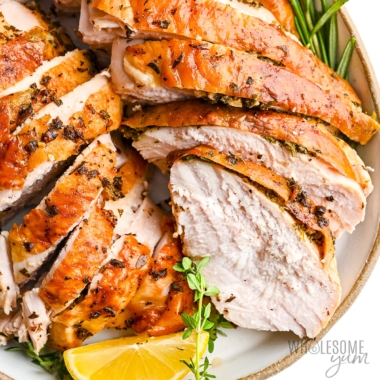
- It’s a show-stopping centerpiece – The stuffed turkey roll slices into beautiful spirals, with golden, crisp skin on the outside and bits of cranberry and cheese inside. It’s so pretty, and perfect for a smaller gathering.
If you want something a little unexpected (but still totally festive) for the holidays this year, make this turkey roulade recipe with me!


Ingredients & Substitutions
Here I explain the best ingredients for my turkey roulade recipe, what each one does, and substitution options. For measurements, see the recipe card.
- Boneless Turkey Breast – I got a 4-pound skin-on turkey breast, and after removing the tenderloins, it yielded about 3.5 pounds. Oh, and if you’re doing grocery delivery, make sure to request one whole piece. I once got two separate halves; I could still roll them together, but the skin didn’t fit all the way around.
- Olive Oil – I brush this on to help the seasoning stick and add a little moisture. Avocado oil or any neutral cooking oil works.
- Seasonings – I used poultry seasoning, garlic powder, salt, and pepper for a classic savory base that lets the filling shine. You can also use Italian seasoning if you don’t have poultry seasoning. And if your turkey breast comes brined, skip the extra salt.
- Gruyere Cheese – It melts beautifully and gives the stuffing a rich, nutty flavor. Fontina or mozzarella are great if you prefer something milder.
- Dried Cranberries – I originally tried to stuff this with my fresh cranberry relish, but it leaked out too easily, and lost all its color and flavor from the turkey juices. Dried cranberries worked a lot better, and retain their color and flavor. Cooked cranberry sauce might also work, but I suspect it would be somewhere in between — better than the relish but not as good as dried cranberries.
- Water – I add a little to the bottom of the pan to keep the turkey moist while it roasts. Chicken broth works, too, and gives the drippings more flavor if you plan to make gravy with them later. (See my tips below!)
- Unsalted Butter – I brush it on at the end to crisp the skin. I tried it without, but this small step makes a big difference.

How To Make A Turkey Roll
I have step-by-step photos here to help you visualize the recipe. For full instructions with amounts and temperatures, see the recipe card.
Making a turkey roulade is actually very easy, and the filling in my recipe doesn’t require any special prep. The main thing is to get the process down to prepare and roll it up, which is exactly what I’ll walk you through here…
Prep The Turkey Breast:
- Separate the skin. Carefully slide your fingers between the skin and the meat to loosen it, working slowly so it doesn’t tear. Once it’s fully separated, lift it off in one piece and set it aside for later.
- Trim the tendon. Open the turkey breast halves like a book and use a sharp knife to cut out the white tendon from the center.


- Remove the tenderloins. Flip the turkey breast over and pull off the smaller tenderloin pieces from the underside. They should remove easily without needing a knife. I usually save them to make turkey soup or turkey salad!
- Butterfly the thick parts. You’ll notice one part of each turkey breast half is thicker than the rest. Make a horizontal cut at that spot and open it like a book. See my picture below with a knife to help you see where to cut!


- Pound thin. Place one turkey breast half between two large sheets of plastic wrap. Use the flat side of a meat mallet to pound to an even thickness. Repeat with the other half.
- Season the turkey. Brush both sides of the turkey breast halves with olive oil, then sprinkle with poultry seasoning, garlic powder, salt, and pepper. Flip and repeat.


Assemble The Turkey Roulade:
- Lay out the skin. Pat the skin dry with paper towels and stretch it out on a large piece of parchment paper. Place the seasoned turkey pieces side by side over it. They’ll make a cute heart shape at this step!
- Add the filling. Sprinkle the Gruyere on first, then the cranberries.


- Roll it up. Start rolling from one end, keeping it tight as you go through both halves.
- Tie it. Use kitchen twine to tie the roll tightly every 1.5 inches, plus one tie going lengthwise. My roll usually ends up about 12″ long and 4″ wide. I try to stretch the skin more as I tie, to keep the skin covering as much of the turkey roll as possible.


Roast In The Oven:
- Bake the turkey roulade. Place it on a rack over a baking sheet (this is the set I use) seam side down. Pour a little water or broth underneath to keep it moist while it cooks. Pop it in the oven and let it roast, rotating the pan partway through so it browns evenly.
- Crisp the skin. Brush the melted butter all over the skin, then crank up the heat to get that golden, crispy finish.
- Let it rest. The roasted turkey roll will get more juicy during this step.
- Slice. Transfer the roulade to a cutting board and slice into spirals, as shown below.



My Recipe Tips
- Drying the skin really well is the key to getting it crispy. It mostly browns on top, not underneath the roll. You can try flipping it to crisp the other side, but I find the roll too fragile and not worth the risk.
- Stretch the skin well so that it can wrap around the roll. I always feel like it’s too small or can’t stretch any more, and then it does. If you don’t stretch it enough, it won’t fit all the way around.
- I leave a 1-inch border when adding the filling. This keeps it from spilling out the sides as you roll and helps everything stay neatly tucked inside.
- You can use either a sheet pan with a rack or a roasting pan here. I usually go with this sheet pan + rack set, which fits the roll perfectly and it’s just my go-to pan for so many things. But a traditional roasting pan like this works, too.
- If you don’t have a rack at all, you can use a bed of onions. Just cut several into large squares and pile them into a baking dish, then place the turkey roulade on top. The onions act like a rack!
- If you want gravy, use broth at the bottom of the pan rather than water. You can then follow my gluten-free gravy recipe using the drippings mixed with the broth in the sheet pan.
- A probe thermometer is super helpful for juicy, perfectly cooked turkey. I take it out when it’s just underdone at 155 degrees F so I can brush on the butter and turn up the heat to brown the skin. After that, I stop at 160-162 degrees F because the internal temp keeps rising as it rests and goes above 165 on its own.
- Make sure to stick your thermometer deep into the center of the turkey roll. I stuck it sideways the first time, thinking I want to avoid the filling, and ended up with the center undercooked. Now I put it right in the center instead, but check a few spots when it hits the right temperature, just to confirm I’m not measuring the filling.
- Don’t skip the resting step. This helps your stuffed turkey roulade finish cooking without drying out the meat, and the juices settle inside instead of spilling out when you slice.
Turkey Roulade (Turkey Roll)
Make my turkey roulade the star of your holiday dinner! This juicy turkey roll is stuffed with sweet cranberries and melty cheese.
 Remove Ads

Instructions
Tap on the times in the instructions to start a kitchen timer.
-
Preheat the oven to 350 degrees F (177 degrees C).
-
Carefully remove the skin from the turkey breast, making sure not to tear it. Set aside.
-
Cut away the tendon from the center of the turkey breast. Pull away the turkey tenderloins and save for another use. Butterfly the thickest part of the turkey breast and open it up to lay flat. Lay the turkey breast halves between large pieces of plastic wrap, and use the flat side of a meat mallet to pound to an even thickness, about 3/8 inch thick. See my post above for pictures of this step.
-
Brush the turkey breast halves with half of the olive oil. Sprinkle them with half of the poultry seasoning, garlic powder, salt, and pepper. Flip and repeat with the remaining oil and seasonings on the other side.
-
Pat both sides of the turkey skin as dry as possible with paper towels. Stretch it as wide as you can on a large piece of parchment paper. Lay the turkey breast halves side by side over the skin.
-
Sprinkle the shredded cheese over the turkey breast halves, followed by the dried cranberries. For both, leave a 1-inch border without filling, which will prevent it from falling out when rolling.
-
Starting with one of the turkey breast halves, roll up the turkey roulade as tightly as you can, continuing with the 2nd turkey breast half. Don't roll the skin. Once fully rolled, wrap the skin tightly around the entire roll. My roll usually comes out to about 12 inches long X 3.5-4.5 inches wide X 3-4 inches tall. Slide long pieces of butcher twine underneath the roll, perpendicular to it, and tie tightly at 1.5-inch intervals. Tie once in the long direction as well.
-
Carefully place the turkey roulade on a rack over a small baking sheet, or in a roasting pan with a rack. Pour a little water or broth into the bottom of the pan underneath the rack, so that it covers the bottom.
-
Roast the turkey roll in oven for 45-65 minutes, rotating the pan around 25-30 minutes in, until the internal temperature reaches 155 degrees F (68 degrees C). Towards the end of the time, melt the butter.
-
Brush the melted butter over the top of the roll, all over the skin. Increase the heat to 475 degrees F (246 degrees C). Roast for 5-10 more minutes, until the internal temperature reaches 162-163 degrees F (72- 73 degrees C) and the skin is golden brown.
-
Remove the turkey roulade from the oven, tent the top with foil, and let it rest for 10 minutes. The internal temperature should reach at least 165 degrees F.
LAST STEP: Leave a rating to help other readers, or tag me @wholesomeyum on Instagram. I’d love to hear from you!
Maya’s Recipe Notes
Serving size: 3 1/2-inch slices, or 1/8 of the entire turkey roll
- Tips: Check out my recipe tips above to help you roll your turkey roulade with confidence, keep the filling inside, and get that crispy golden skin just right.
- Storage: Keep leftovers in an airtight container in the fridge for up to 3-5 days.
- Reheat: Warm gently in the oven with some broth, which helps the turkey stay juicy. I try to avoid the microwave because it dries out fast.
- Freeze: Wrap the turkey roll tightly in plastic wrap and foil, then freeze for up to 3 months. Thaw in the fridge and reheat in the oven to bring back that crispy skin.
I provide nutrition facts as a courtesy. Have questions about calculations or why you got a different result? Please see my nutrition policy.
Add Your Notes Your Notes
Try More Of My Recipes


© Copyright Maya Krampf for Wholesome Yum. Please DO NOT SCREENSHOT OR COPY/PASTE recipes to social media or websites. We’d LOVE for you to share a link with photo instead.
Turkey Roulade

Serving Ideas
If you’re wondering what to serve with this turkey roll recipe, here are a few of my favorite sides to turn it into a full Thanksgiving meal:
- Casseroles – You can’t go wrong with classics like green bean casserole or sweet potato casserole. They both feel extra festive and pair perfectly with the sweet-savory filling in the turkey roulade.
- Easy Sides – I kept it simple with mashed cauliflower and roasted green beans in my picture above. If you want extra sweetness and moisture in addition to the berries inside, spoon my homemade cranberry sauce or cranberry orange relish over the roll.
- Salad – I’ve paired this turkey roll with my fall salad before, but my Thanksgiving salad is also a great match.











4 Comments
Stephanie Davis
0Is there something else to use instead of cheese in the stuffing. We keep kosher and we cannot mix milk and meat. Please give me some other suggestions.
Thank you Maya!!
Maya | Wholesome Yum
0Hi Stephanie, You could try basil pesto sauce (just make it without parmesan cheese) or chimichurri sauce.
~Chrissie O.
0I’m doing a trial run of this tomorrow but with boneless/skinless chicken breasts (not a fan of turkey). I’m gonna stuff with gluten-free-stuffing mix, plus the cranberries and cheese. Our local grocer has MONSTER chicken breasts that are about 1.25-1.5 lbs EACH (!!), which will feed 2-3 people.
But, may I ask, why the skin??? Why not tent foil over the turkey for the majority of the bake time and then spritz with nonstick cooking spray for the last bit to let brown? I always remove the skin because we don’t want the additional calories, and I’ve never missed it, so I was curious about why you saved it. I only came up with preserving moisture, but with broth in the pan, that can be achieved with foil. Thanks for the recipe (LEGIT – if this works, it is going to be SO MUCH EASIER than dealing with a whole bird!!! And I can’t think why it won’t work!!! Pounding is so much easier than carving! lol). And thanks, too, for satisfying my curiosity!!! Happy Thanksgiving to you and yours!!! ~Chrissie
Maya | Wholesome Yum
0Oh, let me know how the chicken breasts turn out, Chrissie! The timing will probably be different so just check on them. The skin does preserve moisture, but also helps to keep the filling inside, gets crispy, and many people like it. If you don’t like the skin, covering with foil should preserve moisture well combined with the broth. My only concern would be whether the filling would leak out, especially the cheese, but it might be fine. Let me know how it goes if you try it. Happy Thanksgiving!